A New Brief Glossary for Taoist Yoga
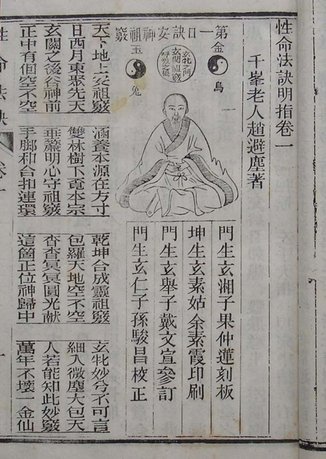
Charles Luk used the Wade-Giles system of transliteration,
which has now been largely replaced with the system of modern pinyin developed
on the mainland of China. Both systems
use the Roman alphabet to phonetically represent the ideograms that comprise the
written Chinese language. Today, people
in the Western world have a more or less immediate access to a wealth of
information (through the internet) regarding China and its culture, which was
unthinkable during the 1960’s. Just as
Charles Luk was breaking new ground with his ‘Taoist Yoga’ translation, today
effort must be made to update the knowledge already possessed in the West,
about the practice of Daoism developed in the East. New and innovative ways must be found to make
the traditional knowledge relevant to a modern and post-modern world, premised
upon logic and science. Zhao Bichen has
already started this process, and through Charles Luk’s translation, sincere
Western students of the Dao can take the teachings forward – all this process
requires is correct and reliable information free of prejudice and ignorance. In this regard, readers are advised to also
consult the extensive Glossary (Pages 177-199 of Taoist Yoga) that Charles Luk
has provided, and to utilise what follows as a means of gaining perspective and
context on the path of Daoist self-cultivation.
Concept Pinyin Ideogram Wade-Giles
Chao Pi Ch’en = Zhao Bichen (赵避尘) Chao Pi Ch’en
Zhao Bichen (1860-1942 – accomplished Daoist master and author of a number of Daoist books including the subject of Charles Luk’s ‘Taoist Yoga’, entitled ‘The Secrets of Cultivation of Essential Nature and Eternal Life’ (性命法訣明旨 – Xing Ming Fa Jue Ming Zhi).
Chao K’uei I = Zhao Kuiyi (赵魁一) Chao K’uei I
Renowned elder brother of Zhao Bichen and – fellow advanced Daoist practitioner particularly known for his martial arts mastery. Throughout his manual, Zhao Bichen mentions his brother with the utmost of respect.
Taoist Yoga = Dao Neidan (道內丹) Tao Nei Tan
The chosen English language title for Zhao Bichen’s translated book entitled ‘The Secrets of Cultivation of Essential Nature and Eternal Life’ (性命法訣明旨 – Xing Ming Fa Jue Ming Zhi).
Three Fields of Centred Energy (三丹田 – San Dan Tian)
Concept Pinyin Ideogram Wade-Giles
Chao Pi Ch’en = Zhao Bichen (赵避尘) Chao Pi Ch’en
Zhao Bichen (1860-1942 – accomplished Daoist master and author of a number of Daoist books including the subject of Charles Luk’s ‘Taoist Yoga’, entitled ‘The Secrets of Cultivation of Essential Nature and Eternal Life’ (性命法訣明旨 – Xing Ming Fa Jue Ming Zhi).
Chao K’uei I = Zhao Kuiyi (赵魁一) Chao K’uei I
Renowned elder brother of Zhao Bichen and – fellow advanced Daoist practitioner particularly known for his martial arts mastery. Throughout his manual, Zhao Bichen mentions his brother with the utmost of respect.
Taoist Yoga = Dao Neidan (道內丹) Tao Nei Tan
The chosen English language title for Zhao Bichen’s translated book entitled ‘The Secrets of Cultivation of Essential Nature and Eternal Life’ (性命法訣明旨 – Xing Ming Fa Jue Ming Zhi).
Three Fields of Centred Energy (三丹田 – San Dan Tian)
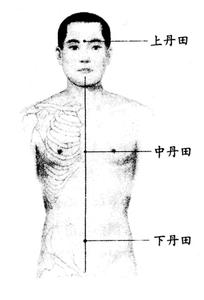
Lower energy centre = xia dan tian (下丹田) hsia
tan t’ien
Two inches below navel
Middle energy centre = zhong dan tian (中丹田) chung tan t’ien
Solar plexus
Upper energy centre = shang dan tian (上丹田) shang tan t’ien
Centre of forehead
Ancestral cavity = zu qiao (祖窍) tsu ch’iao
Ancient cavity - centre of forehead (synonymous with upper dan tian)
Three Treasures (三寶 – San Bao)
Generative force = jing (精) ching
Vital breath/force = qi (氣) ch’i
Spirit/empty mind = shen (神) shen
Other Important Terms
Immortality/Immortal = xian (仙) hsien
Microcosmic orbit/ = xiao zhou tian (小周天) hsiao chou tien
Lesser self-circulating divine-energy
Macrocosmic orbit/ = da zhou tian (大周天) da chou tien
Greater self-circulating divine-energy
Psychic channel/ = jing Luo (經絡) ching luo
Qi flow meridian
Supreme ultimate = tai ji (太極) t’ai chi
Grand Ridgepole of Unity
Cavity = qiang (腔) ch’iang
Area within the body of energised psycho-physical awareness – also bodily area containing organs.
Lesser attainment of serenity = xiao ting qing (小靜情) hsia ting ching
Lit: ‘small quiet mind’
Great attainment of serenity = da ting qing (大靜情) ta ting ching
Lit: ‘great quiet mind’
Ni wan = ni wan (泥丸) ni wan
Lit: ‘mud pill’
An area corresponding to the anatomical centre of the structure of the brain organ, and in developmental and medicinal terms, is related to, but distinct from, the upper tan t’ien, and the ‘divine-sky aperture’ (天门 – Tian Men), situated at the centre of the top of the skull bone, as well as the ‘ground gate’ (地门 – Di Men) situated at the base (or ‘tail’ area) of the spine.
Prenatal = xian tian (先天) hsien t’ien
Lit: ‘before the divine sky’
This refers to the pristine state of innate energy in the body prior to birth into the physical world – and the cutting of the umbilical-cord connecting the baby to the mother. In this pre-birth, or pre-natal state, the baby does not breath through the nose and mouth, and generative force, (jing), vitality (qi), and empty spirit (shen), are not yet sullied through the experience of the external world. Daoist self-cultivation aims to restore this ‘pre-natal’ unified purity whilst living in the world.
Postnatal = hou tian (後天) hou t’ien
Lit: ‘after divine-sky’
The ordinary state of life in the world entered immediately after the birthing process. The human being breaths through the nose and mouth, and due to the sensing and abiding in the physical world amongst various objects, perception splits into a basic duality, and generative force (jing), vitality (qi), and empty spirit (shen), lose the unified state as existant during the ‘pre-natal’ period. Daoist cultivation strives to re-acquire the ‘prenatal’ breath (that is not reliant upon the process of ordinary breathing), by harnessing and refining the postnatal state, and in so doing, reverting to a earlier pristine state.
All pervading one = yi guan (一貫) i kuan
Lit: ‘Connected in Oneness’
An important Confucian term denoting an underlying (and realisable) universal interconnectedness. Often translated as ‘One Reality’ within Taoist Yoga.
Incorporeal soul = hun (魂) hun
Lit: ‘cloud spirit’
Associated with yang energy, hun is the part of the human spirit that can leave the physical body and ascend into the divine sky. This can happen at the death of the physical body, or in the case of a sage, be the consequence of an act of will whereby hun leaves the body and travels around the universe, before returning to that body.
Corporeal soul = po (魄) p’o
Lit: ‘vigour of physical life’
Associated with yin energy, po is the part of the human spirit permanently associated with physical matter of the human body. It cannot detach from the physical body and soar into the heavens like hun, but upon the death of the physical body, drops down into the earth.
Prana = zhen qi (真炁) chen ch’i
Lit: ‘genuine energy’
Highly refined qi-energy. Prana is the Indian Sanskrit term which is considered synonymous with ‘zhen qi’ within Daoist self-cultivation.
Triple burner = san jiao (三焦) san ch’iao
Two inches below navel
Middle energy centre = zhong dan tian (中丹田) chung tan t’ien
Solar plexus
Upper energy centre = shang dan tian (上丹田) shang tan t’ien
Centre of forehead
Ancestral cavity = zu qiao (祖窍) tsu ch’iao
Ancient cavity - centre of forehead (synonymous with upper dan tian)
Three Treasures (三寶 – San Bao)
Generative force = jing (精) ching
Vital breath/force = qi (氣) ch’i
Spirit/empty mind = shen (神) shen
Other Important Terms
Immortality/Immortal = xian (仙) hsien
Microcosmic orbit/ = xiao zhou tian (小周天) hsiao chou tien
Lesser self-circulating divine-energy
Macrocosmic orbit/ = da zhou tian (大周天) da chou tien
Greater self-circulating divine-energy
Psychic channel/ = jing Luo (經絡) ching luo
Qi flow meridian
Supreme ultimate = tai ji (太極) t’ai chi
Grand Ridgepole of Unity
Cavity = qiang (腔) ch’iang
Area within the body of energised psycho-physical awareness – also bodily area containing organs.
Lesser attainment of serenity = xiao ting qing (小靜情) hsia ting ching
Lit: ‘small quiet mind’
Great attainment of serenity = da ting qing (大靜情) ta ting ching
Lit: ‘great quiet mind’
Ni wan = ni wan (泥丸) ni wan
Lit: ‘mud pill’
An area corresponding to the anatomical centre of the structure of the brain organ, and in developmental and medicinal terms, is related to, but distinct from, the upper tan t’ien, and the ‘divine-sky aperture’ (天门 – Tian Men), situated at the centre of the top of the skull bone, as well as the ‘ground gate’ (地门 – Di Men) situated at the base (or ‘tail’ area) of the spine.
Prenatal = xian tian (先天) hsien t’ien
Lit: ‘before the divine sky’
This refers to the pristine state of innate energy in the body prior to birth into the physical world – and the cutting of the umbilical-cord connecting the baby to the mother. In this pre-birth, or pre-natal state, the baby does not breath through the nose and mouth, and generative force, (jing), vitality (qi), and empty spirit (shen), are not yet sullied through the experience of the external world. Daoist self-cultivation aims to restore this ‘pre-natal’ unified purity whilst living in the world.
Postnatal = hou tian (後天) hou t’ien
Lit: ‘after divine-sky’
The ordinary state of life in the world entered immediately after the birthing process. The human being breaths through the nose and mouth, and due to the sensing and abiding in the physical world amongst various objects, perception splits into a basic duality, and generative force (jing), vitality (qi), and empty spirit (shen), lose the unified state as existant during the ‘pre-natal’ period. Daoist cultivation strives to re-acquire the ‘prenatal’ breath (that is not reliant upon the process of ordinary breathing), by harnessing and refining the postnatal state, and in so doing, reverting to a earlier pristine state.
All pervading one = yi guan (一貫) i kuan
Lit: ‘Connected in Oneness’
An important Confucian term denoting an underlying (and realisable) universal interconnectedness. Often translated as ‘One Reality’ within Taoist Yoga.
Incorporeal soul = hun (魂) hun
Lit: ‘cloud spirit’
Associated with yang energy, hun is the part of the human spirit that can leave the physical body and ascend into the divine sky. This can happen at the death of the physical body, or in the case of a sage, be the consequence of an act of will whereby hun leaves the body and travels around the universe, before returning to that body.
Corporeal soul = po (魄) p’o
Lit: ‘vigour of physical life’
Associated with yin energy, po is the part of the human spirit permanently associated with physical matter of the human body. It cannot detach from the physical body and soar into the heavens like hun, but upon the death of the physical body, drops down into the earth.
Prana = zhen qi (真炁) chen ch’i
Lit: ‘genuine energy’
Highly refined qi-energy. Prana is the Indian Sanskrit term which is considered synonymous with ‘zhen qi’ within Daoist self-cultivation.
Triple burner = san jiao (三焦) san ch’iao
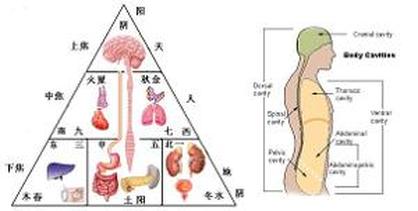
The triple heater represents psycho-physical areas in the
thoracic, abdominal and pelvic cavities which represent centres of intense
energy production, that do not exclusively correspond to any specific organ,
but which are related to organs in general, and the metabolism associated with
those organs. In one theory, the upper
burner (上焦 – Shang Jiao) extends from the
heart to the head.
©opyright: Adrian Chan-Wyles (ShiDaDao) 2014.
©opyright: Adrian Chan-Wyles (ShiDaDao) 2014.